

My mind seems to go through cycles as I explore my corner of the universe. Similar to the presence/self-reflection cycle of lived experience, my views on philosophy cycle between intellectual investigation and practical applications. I’ve been on a deep-dive into emptiness, which seemingly arose from my presence practice.
When I first learned about nihility - nothing matters, nothing is real, everything eventually dissolves into meaninglessness - I had a typical response of “well, why do anything?” It seems like a very depressing dead end, but then I woke up the next morning with things to do and while those things hadn’t changed, something in me had. I didn’t realize it immediately and I couldn’t pinpoint it. Once my brain had processed a new reality of sorts, it felt like a new freedom. I could create my own meaning, however fleeting or naive, and I emerged from the depression of meaninglessness into a world of possibility again (the first of many cycles between the two).
This was a surface-level understanding and application of what one philisopher, Keiji Nishitani, called sunyata - emptiness.
Nihility says nothing has value.
Emptiness says nothing has value on it’s own.
For Nishitani, emptiness isn’t a void, it’s a relational field. Everything exists only in relation to everything else. We can start at the beginning with language. Language is the original tool that we built civilization on. And yet words don’t have meaning on their own. We are so trained on this tool, language is so engrained in our shared experience that we generally think ‘things’ have an essence to themselves. They don’t. A tree is not ‘a thing.’ It’s the vibrational resonance of soil, sun, fungus, air, time, and chance forming into a shared reality we attach the label ‘tree’ to.
This holds true all the way down to the thing we call ‘self.’ Self is relationships, memories, habits, suffering, love, biology, culture. If I ask you who you are, that’s what you use to describe it, and it’s ever changing. When we stop insisting that any ‘thing’ possesses an independent, fixed meaning, says Nishitani, we dont’ fall into despair - we fall into connection.
I first started applying The Puzzle to the actions of my life. Then I started applying it to my entire ontology, not as a metaphor or explanation of anything, but as a way of seeing everything. With this lens I can see Nishitani’s sunyata without spiraling into abstraction.
When I look at life as a Puzzle, I can better understand concepts like:
No single puzzle piece means anything on it’s own
Pieces only make sense in relation to their adjacent pieces - the tabs make sense in how they fit with others
Unlike a traditional jigsaw the picture isn’t pre-determined, it’s formed as it’s built
The Collective Puzzle is never finished
We don’t ‘own’ our pieces - we find them, we create them, then they only contribute to meaning when we place them in the emptines

s
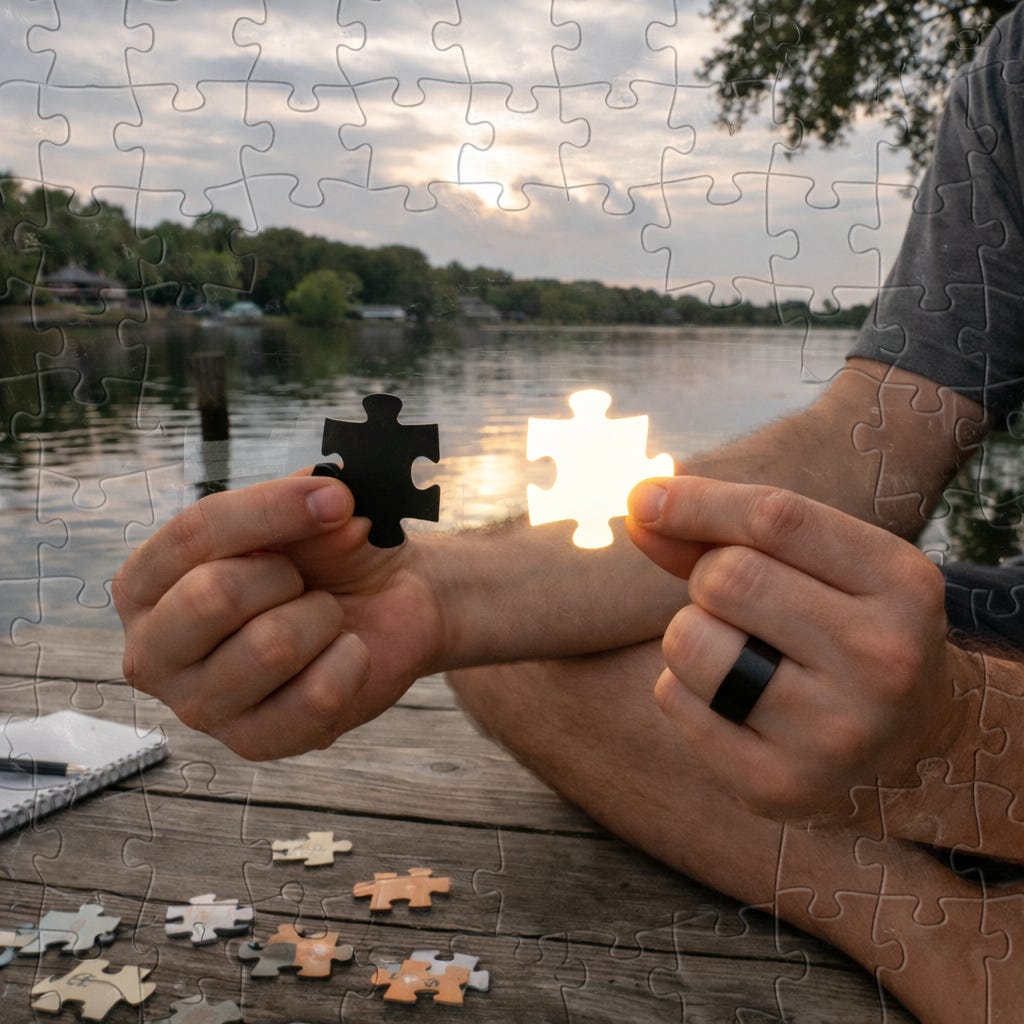
Emptiness is not absence, it’s not nihilism, it’s relational meaning. The Puzzle helps me see a meaning that feels “grounded in the ungrounded.” Simplified it’s like waves in the ocean realizing the are the ocean. Meaning isn’t inside the pieces, it arises between them. So the connection point is where to focus presence. The application of presence to the world around us.
Sitting with nihility is realizing the picture we thought we were building isn’t real. Emptiness is realizing there never was one picture, and that’s ok. Once emptiness is seen clearly, individuality doesn’t disappear, we don’t lose ourselves. We realize we are contextual. My Puzzle does exist, and yours does to, but there are no edges. Everything is connected, interlocking, reshaping, borrowing pieces to build The Collective Puzzle. It’s not mystical or metaphorical grasping at the unknown. It’s just our shared reality when we stop pretending anything stands alone.
Helping each other with our puzzles isn’t applying our individual meaning to the outside world. Helping each other is meaning emerging through the interdependence of shared reality. And that kinda makes presence the language of meaning. We place pieces because placing pieces is the now, the current moment. If we don’t demand anything from the moment, down to there being no essence to the moment, we can still choose, we can build, we can care. Not because it matters but because every piece is the connection - the freedom on the other side of emptiness.
"We believe in nothing, Lebowski. Nothing. And tomorrow we come back and we cut off your chonson"
👊